
The electric scooter has become one of the most comfortable and fastest ways to move around urban environments. Its popularity has grown so much that it is no longer just an occasional accessory for tourists or locals, but a regular means of transport that shares space with cars, motorbikes, bicycles and pedestrians. However, not everything goes: the regulations are clear and, in Gran Canaria, they have their own nuances that are worth knowing before hopping on one.
What are the current regulations for electric scooters in Spain?
Before looking at the particularities of the island, it is important to understand the general framework that regulates their use throughout the country. The Directorate General of Traffic (DGT) classifies electric scooters as personal mobility vehicles (PMVs) and sets specific conditions for their circulation to be safe and orderly.
Recent changes in the Traffic Law
In recent years, the law has evolved to adapt to the growing use of PMVs. Currently, every scooter manufactured from 2024 onwards must mandatorily have a circulation certificate issued by the manufacturer or importer, along with a document certifying that it meets the required technical standards. Older models must have this certificate before 2027. The obligation to wear a helmet has also been unified throughout the territory, and penalties for serious offences such as riding under the influence of alcohol or drugs have been strengthened.
Official definition of PMV (personal mobility vehicle)
The DGT defines a PMV as a vehicle with one or more wheels, powered exclusively by an electric motor, with a maximum speed between 6 and 25 km/h. This category includes electric scooters, but not electric bicycles with pedal assistance nor other devices that exceed these speed limits.
Categories, speeds and designated areas
In Spain, electric scooters can only circulate on urban roads where the speed limit is equal to or below 30 km/h. They are not allowed on pavements or pedestrian areas, and must follow the same traffic rules as other vehicles regarding traffic lights, signs and priority.
Specific requirements for riding in Gran Canaria
On the island, national regulations are complemented by municipal by-laws that adapt the rules to local reality. This means that the conditions for riding in Las Palmas de Gran Canaria are not exactly the same as in San Bartolomé de Tirajana or Mogán.
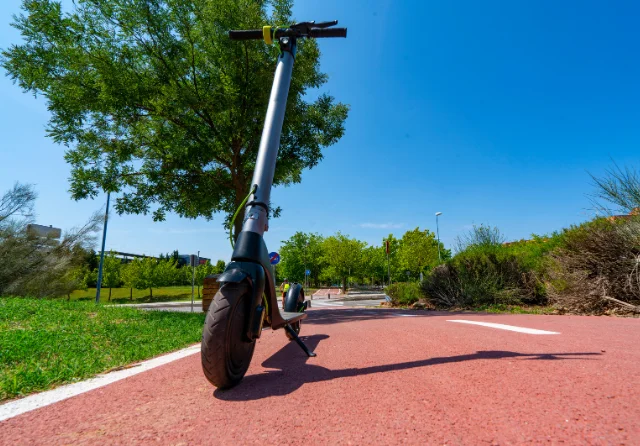
Municipal adaptation of the regulations
Each local council may set stricter rules to ensure safety on its streets. For example, in areas with high tourist influx it is common for speed to be limited to under 20 km/h or for scooter circulation to be restricted during certain hours.
Prohibited areas and local restrictions
In Las Palmas de Gran Canaria, it is forbidden to ride electric scooters along the Paseo de Las Canteras and in areas of high pedestrian density. In San Bartolomé de Tirajana, by-laws restrict their use in busy sections of Playa del Inglés and Meloneras, especially on seafront promenades and commercial avenues.
Rules in Maspalomas, Playa del Inglés and tourist areas
In the main tourist centres of the south, the aim is to protect pedestrians and maintain coexistence. Therefore, scooter use is concentrated on cycle lanes, residential streets and secondary roads. Pavements, promenades and landscaped areas are off limits for these vehicles, unless specific signage indicates otherwise.
Where can and can’t electric scooters circulate?
Although the general rule is simple, it is not always clear which spaces are permitted. It is worth reviewing to avoid fines.
Prohibited on pavements and pedestrian areas
Electric scooters cannot travel on pavements, parks, squares or pedestrian zones. Pedestrians always have priority in these spaces, and the circulation of PMVs is considered a punishable offence.
Permitted on cycle lanes and urban roads <30 km/h
The safest and most legal place to ride a scooter is the cycle lane. They are also allowed on urban roads where the speed limit does not exceed 30 km/h, respecting the direction and flow of traffic.
Interurban roads, tunnels, motorways: strictly prohibited
It is not permitted to ride on interurban roads, crossings, motorways, dual carriageways, or urban tunnels. These roads are designed for faster vehicles and represent a high risk for scooter users.
What elements are mandatory to ride legally?
The law requires certain technical and safety requirements that every scooter and its rider must comply with.
Circulation certificate (mandatory from 2024)
This is the document certifying that the scooter meets the DGT technical specifications. For new models it is mandatory from 2024, and for existing ones it will be from 2027.
Helmet (mandatory throughout Spain)
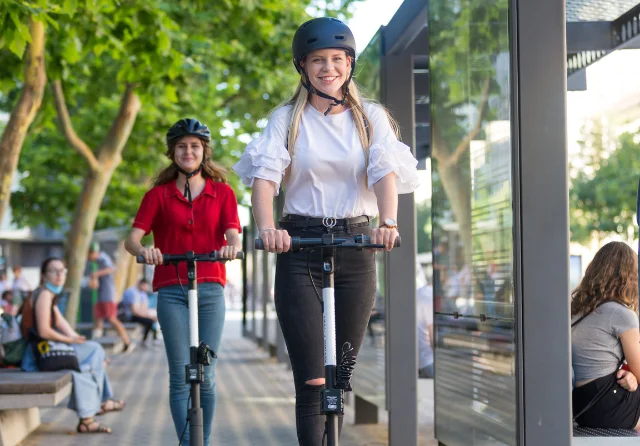
Regardless of the user’s age or the city where they ride, wearing a helmet is mandatory. It must be approved and properly adjusted to ensure its function in the event of an accident.
Lights, reflectors and bell
To ensure visibility, scooters must be equipped with front and rear lights, reflective elements, and a bell. In addition, if riding at night or in low light, the user must wear reflective clothing.
Insurance
The law does not require insurance to ride an electric scooter, but it is advisable to take one out, especially to have coverage in case of causing damage to third parties.
What are the most common fines with electric scooters?
Financial penalties can be high and, in some cases, accumulate.
Riding on pavements → up to €200
Riding in pedestrian areas is a minor offence that can cost up to €200, in addition to the immediate confiscation of the vehicle.
Without a helmet or with headphones → up to €500
Not wearing a helmet or riding with headphones on is fined up to €500, as it is considered a serious safety risk.
Alcohol, drugs or excessive speed → up to €1,000
The most serious offences, such as exceeding the alcohol limit or riding under the influence of drugs, can reach fines of up to €1,000, as well as the immobilisation of the vehicle.
Recommendations if you are going to rent an electric scooter in Gran Canaria
If you are considering renting an electric scooter during your stay on the island, it is worth taking some precautions.
Check that the vehicle has a certificate and lights
Before setting off, make sure the scooter has a circulation certificate and that the lights and reflectors are working properly.
Wear a helmet and avoid prohibited areas
Even if the journey is short, the helmet is essential. In addition, avoid riding on pavements or in high pedestrian density areas to prevent fines.
If you want to move around Gran Canaria quickly and while complying with all the rules, at Scooter and Bike Rental you will find inspected electric scooters, with helmet included and ready to legally circulate in permitted areas. We look forward to your next ride!