
Bicycle maintenance starts with checking the bike’s condition before touching anything. If a wheel rubs, the headset has play, or the brake has lost its feel, lubricating the chain won’t solve the problem. First, you must detect which component is malfunctioning, and then apply the appropriate maintenance.
On a bike used frequently, wear appears progressively. The chain loses lubrication, brakes show signs of use, and tyres gradually change their contact patch with the ground. A well-planned bike maintenance routine isn't about randomly checking parts; it's about following a logical order to keep the bike safe, precise and ready to ride.
Initial check before working on the bike
Before cleaning, lubricating or adjusting, the bike needs a quick status check. This inspection helps detect problems that cannot be fixed with basic maintenance and which might affect everything else. If you need to locate each part better before checking, you can consult this guide on basic road bike components.
Start with the wheels. Spin them and observe if they rub at any point. Continuous rubbing can come from a misaligned calliper or an improperly seated wheel. If the rubbing only appears in one part of the rotation, it is usually more related to a slightly bent disc or a wheel that is out of true.
Next, check the headset. With the front brake applied, move the bike back and forth. If you feel a sharp knock in the area of the stem or fork, there is play. In that case, it makes no sense to keep adjusting other parts without first correcting that point.
It is also useful to check the brake feel before getting into the drivetrain. If the lever travels too close to the handlebar or the brake loses bite, check the pads, disc and adjustment before continuing with the rest of the maintenance.
Bicycle chain maintenance
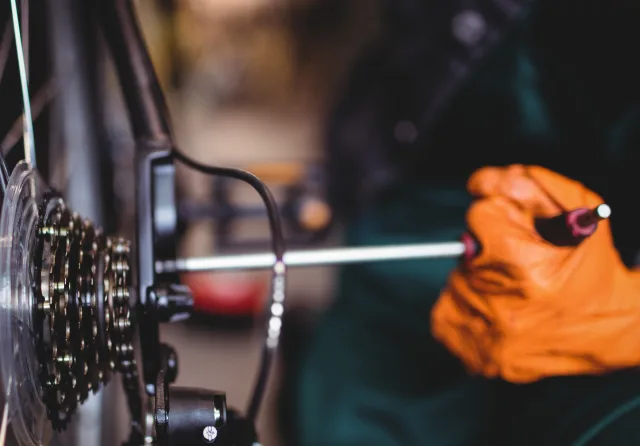
The chain accounts for a significant portion of drivetrain wear, so its maintenance must be constant. First, remove visible dirt with a cloth. If there is stuck-on grease, use a specific degreaser and dry well before lubricating.
The lubricant is applied to the inside of the chain, where the links work as they pass through chainrings and sprockets. After distributing it by turning the pedals, remove the excess. Oil on the outside does not improve performance and attracts more dirt.
You must also monitor wear with a chain checker. If you change it in time, you protect your cassette and chainrings. If you wait until it skips under load, the repair will likely affect more parts.
Maintenance of gears, brakes and wheels
After checking the chain, test the components that most affect bike control while riding. In this part of the maintenance, look at three things: that the gears respond without jumping, that the brakes maintain power, and that the wheels spin straight.
Gear and drivetrain maintenance
If the gears are slow to shift up or down sprockets, start by checking the chain and cassette. The problem is not always in the derailleur itself: it could also come from a cable with low tension, a dirty housing or a slightly bent derailleur hanger.
If the fault always appears on the same sprocket, check that specific point of the drivetrain. If the chain skips when pedalling hard, there may be wear on the chain or the cassette.
Bicycle disc brake maintenance
In bicycle disc brake maintenance, avoid any greasy products near the disc or pads. If the brake squeals and loses bite, the problem could be contamination.
Also check the pad wear. If there is little material left, change them before damaging the disc. On hydraulic brakes, a lever that travels too close to the handlebar usually indicates air in the circuit or the need for bleeding.
Wheel and tyre maintenance
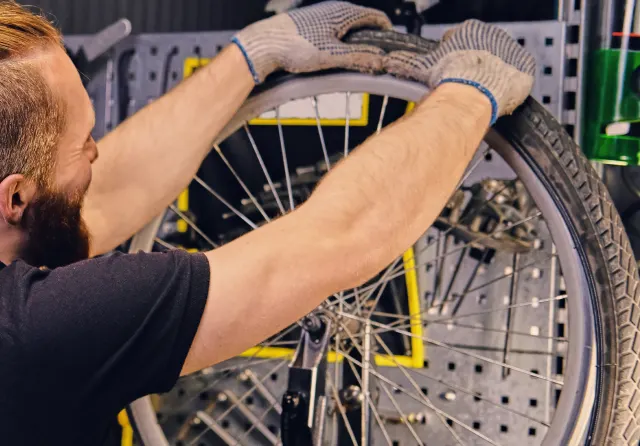
Wheel and tyre maintenance starts with pressure. Measure it with a pressure gauge, because feel by hand is not a reliable reference.
Also check the condition of the tyres. Sidewall cuts, cracks and deformed areas indicate wear or structural damage. If the wheel doesn’t spin straight, it may need truing or a spoke check.
Bicycle fork maintenance
Bicycle fork maintenance depends on the type of suspension and how the bike is used. For a suspension fork, the basics are to keep the stanchions clean and check that the seals do not accumulate dirt. If dust enters that area, internal wear increases.
After rides in mud or lots of dust, wipe the stanchions clean with a clean cloth before putting the bike away. Also check if oil appears near the seals or if the fork feels jerky. These are signs that the service should be done by a workshop.
Air pressure, if the fork has it, is adjusted with a specific suspension pump. It should not be done with a standard tyre pump.
Maintenance according to bicycle type
The type of bicycle determines the type of service. On an MTB, pay more attention to drivetrain dirt, tyre cuts and suspension performance. On a road bike, the check focuses more on the chain, tyre pressure and tyre condition.
Mountain bike maintenance
Mountain bike maintenance should be carried out more frequently when riding in mud, dust or over rocky terrain. The drivetrain becomes dirty quickly and the suspension works harder. After a demanding ride, inspect the chain, clean the fork stanchions and check the tyres for cuts.
Road bike maintenance
Road bike maintenance focuses more on precision. The chain must be clean and well-lubricated, because wear eventually affects the cassette. You must also check the tyres before long rides, especially if you work with high pressures.
If you are reviewing posture, saddle height or the feeling of control, this guide on how to choose the correct bike size may also help you.
When to maintain your bike at home and when to visit a workshop
Maintenance at home makes sense when the bike shows no clear faults and only needs a basic check. In that case, it is enough to work on routine care tasks, without getting into adjustments that require specific tools or mechanical expertise.
The workshop comes in when the bike stops responding as it should after that basic check. If the problem continues, it is reasonable to stop and locate the cause precisely. Continuing to work on components without a diagnosis can shift the fault to other areas.
It is also advisable to go to a workshop after a crash, in the face of a clear loss of performance, or when a part shows advanced wear. In those cases, home maintenance is no longer sufficient and the bike needs a technical service.
Maintenance reduces mechanical failures, but safety also depends on the kit you use; you can complete your check with this guide on protective gear for cycling.
If you are going to ride a bike during your holidays, sometimes it is more practical to hire than to travel with your own. You save on transport, adjustments upon arrival, and the pre-ride service often needed after moving the bike.
In the south of Gran Canaria, Scooter and Bike offers bike hire in Maspalomas giving you access to a bike already serviced and ready to ride. It is a useful option if you want to do occasional routes or get around the area without lugging your own bicycle. We look forward to seeing you!
Scooter & Bike Rental is a bicycle and scooter hire company. We do not offer repair, workshop or maintenance services for privately owned bicycles or scooters.